I helped rehaul Viata's mobile UI, reducing user frustration for a novel mapping algorithm by 60% in a 5-week sprint.
context
Role
UX Designer
Team
Me
Lead Designer
Engineers
Chief Scientist
Skills
User Research
Prototyping
Timeframe
Apr 2024 - May 2024
overview
Turning mobile from afterthought to strength
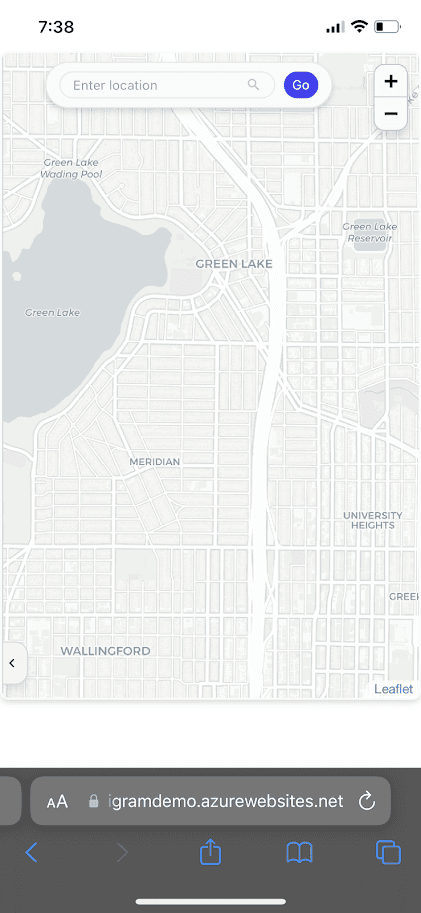
When Viata (fka Traffigram) prepared to launch its homebuyer tool, we discovered that our mobile experience was a direct port of desktop! We were completely blindsided by this, and with our launch date approaching, we wanted to ensure a sound mobile experience.

Travel Times
Add places you might travel to from your new home often, such as a workplace or school.
Location*
Enter Location
Label
i.e. Work
Add
Location 1
-- min.
Location 2
-- min.
Location 3
-- min.
Location 4
-- min.
Powered by
Traffigram
unused space
unused space
side panel toggle hard to see
inacessible touchpoints
Users during early testing pointed out that the panel to configure routing was difficult to find, and the inputs were small and imprecise.
During early user testing, 80% of participats expressed frustration with the layout, particularly when it came to route input and navigation.
BACKGROUND
Visualizing spatial accessibility at a glance
Traffigram's novel algorithm distorts maps based around travel time instead of travel distance, enabling users to make split-second travel decisions when considering multiple destinations at once.
The rings surrounding the origin point (isochrones) allow users to quickly interpolate travel time to their desired location. Background research on this technology has found that users can make travel decisions over 2x faster and with 40% less frustration when compared to normal maps, without sacrificing accuracy.
After entering an origin point, Traffigram distorts a map to visually show the travel times to four different pizza restaurants.